A 34‑year‑old mum and Granada Reports journalist, Rachel Hall, has shared how a routine health MOT unexpectedly led to a thyroid cancer diagnosis — and how specialist teams at The Christie NHS Foundation Trust supported her through surgery, radioactive iodine treatment and ongoing monitoring.
Rachel, who worked as a journalist on ITV’s Granada Reports, booked the MOT on a whim after her husband received a discount for a full body scan. With no symptoms and no health concerns, she expected the results to be uneventful. Instead, within days, her life changed dramatically.
The scan revealed a large growth in her neck measuring 7cm by 4cm. “I assumed it was a typo,” Rachel said. “But when I felt my neck, it was there — roughly the size of a lemon. I had no idea. How often do you feel your neck?”
She was referred urgently to an endocrinologist, and within a week underwent further scans and a needle biopsy. While working on location for Granada Reports, she received the call asking her to come into hospital the same day. “That’s when I knew it was serious,” she said.
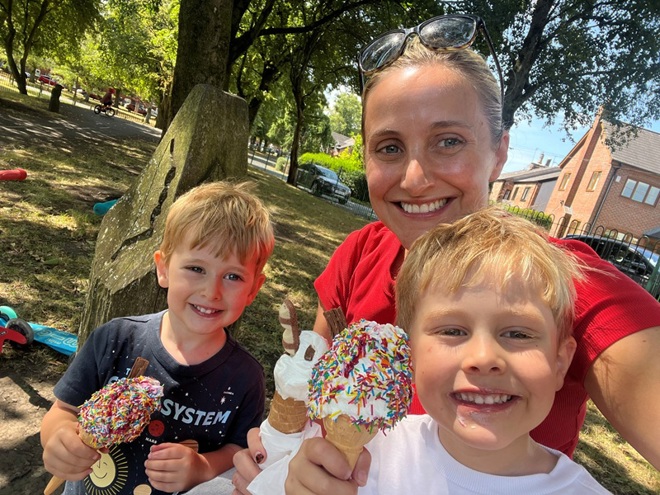
The biopsy results were concerning, and although doctors could not confirm cancer at that stage, they advised surgery to remove half of her thyroid. Rachel’s biggest fear was the impact on her young children — two boys aged 1 and 3. The day before her operation, she bought each of them a teddy bear dressed as a doctor, with a recording of her voice inside telling them she loved them, in case her vocal cords were affected during surgery.
Shortly after surgery, tests confirmed 2 cancerous tumours, one showing vascular invasion. The decision was made to remove the remaining half of her thyroid and proceed with radioactive iodine treatment at The Christie.
“It all felt like a blur,” Rachel said. “My youngest turned 2, my 3‑year‑old started school, and my step‑daughter was starting secondary school. It didn’t feel real. Naively, it never occurred to me that at 34 I could have cancer.”
Rachel had visited The Christie many times professionally while working in journalism, covering the hospital’s world‑leading research and care. “But nothing prepared me for being a patient,” she said. “Everyone makes it as easy as possible. The care is exceptional.”
One of the hardest moments was telling her 11‑year‑old step‑daughter. “She knew cancer meant something serious and assumed it meant I was dying. I reassured her that thyroid cancer has a great prognosis and that I wasn’t going anywhere — and that I had a team of superstar doctors doing everything they could to make me better.”
In November, Rachel underwent radioactive iodine treatment at The Christie, spending several days in isolation in a specialist room. “It was hard being away from my kids,” she said. “But there was a wonderful woman who brought me a brew and biscuit every day. She chatted about her family and mine and made the experience so much easier. She even helped with my Christmas shopping from afar. She brightened my spirits.”
Post‑treatment scans showed 2 very small remaining growths that are too small to treat currently. Thyroid cancer grows slowly, so Rachel now returns to The Christie every 8 to 12 weeks for scans and blood tests. With no thyroid, she will take levothyroxine for life, and adjusting to her new normal has been challenging — but she is determined to stay positive.
To mark her recovery and thank The Christie, Rachel has signed up to run the London Marathon. “It’s my way of feeling positive about my body again,” she said. “A cancer diagnosis doesn’t mean everything has to stop.”