
News story published 23 November 2026
The first patient has received CT-guided online adaptive radiotherapy at The Christie NHS Foundation Trust.
Online adaptive radiotherapy (oART) allows a patient’s treatment plan to be updated immediately before each session, based on scans taken on the treatment machine on the day itself.
The Christie is the first centre in the North West to offer CT-guided oART and the first in the UK to use the Elekta Evo machine and the Elekta One Online delivery platform.
This new CT-guided oART service complements the existing MRI-guided oART service at The Christie on the MR-Linac.
Usually, the treatment plan in radiotherapy is based on a scan taken before the course of treatment begins. While imaging is routinely used to check the patient's position before treatment, oART goes a step further by allowing the clinical team of doctors, physicists and radiographers to assess changes in the patient's anatomy on each day of treatment and adapt the treatment plan accordingly. This could allow the radiation to be targeted more precisely, helping to protect nearby healthy tissue and potentially reduce side effects.
The treatment is initially available for selected patients with cancers in the pelvic region, with plans to expand its use to other tumour sites in the coming months.
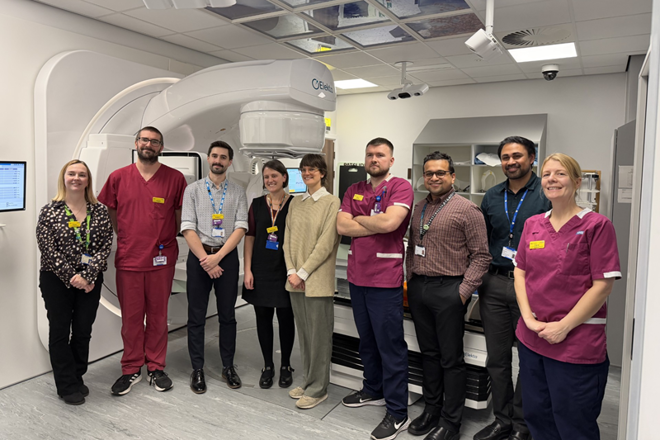
Rachael Hall, Adaptive Lead for Radiotherapy Physics, said: “The development of this new service has been a great opportunity to explore new ways of working as a large multidisciplinary team and evolve the treatments we offer our patients. We’re really excited about the potential benefits we may be able to achieve and the possibility of delivering oART for more patients.”
Dr Deep Chakrabarti, Consultant Clinical Oncologist specialising in genitourinary cancers at The Christie, said: “We have already seen the potential of online adaptive radiotherapy using MRI-guided technology, but CT-guided adaptive radiotherapy offers the opportunity for much wider adoption. CT-guided adaptation can offer shorter treatment sessions compared with MRI-guided approaches, making personalised radiotherapy more accessible and convenient for patients.
“This ability to personalise treatment daily could help us deliver radiotherapy more precisely, with the aim of reducing unnecessary radiation exposure to healthy tissues. We are continuing to gather evidence on its clinical benefits.
“The treatment is currently available on one machine, with plans to expand the service. This is a really exciting development for The Christie and an important step towards our ambition of making radiotherapy more personalised, gentler and kinder for our patients.”