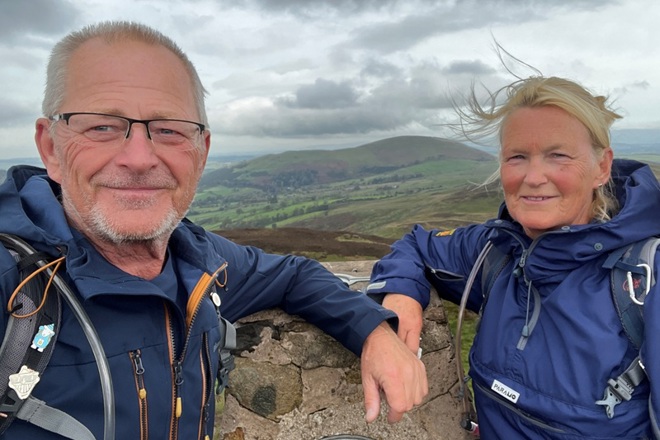
Mark England, a 68-year-old dad and granddad from Sale now living in Sandbach, Cheshire, was diagnosed with bladder cancer in early December last year. He is currently being treated with targeted therapy and immunotherapy at The Christie NHS Foundation Trust, a specialist cancer centre in Manchester.
Mark, who worked for a bank for over 40 years before retiring, is the first patient to join the MANIFEST study, one of the largest immunotherapy studies in the country. Led by The Christie, researchers want to recruit 3,000 people from across the country who are about to have immunotherapy for the first time for breast, bladder, kidney, or skin cancer. The aim is to understand why immunotherapy works for some people and not for others.
Patients like Mark will be followed over 4 years, with researchers collecting detailed biological samples, clinical information, and immune system data at key stages of their treatment. The data will form a national resource for scientists, clinicians and industry partners to accelerate discovery and improve patient care across the NHS and worldwide.
“When I was asked to take part, I said yes straight away. We can only get new treatments for this awful disease if people like me take part in research. It was a no-brainer. It won’t help me, but it might help someone like me in the future, so it’s worth it,” he says of taking part in the study.
Mark, who has been with partner Debbie for over 30 years and loves hiking and playing the guitar, went back and forth to the GP after noticing he was peeing a lot more than usual. He had some tests, but they remained inconclusive. At the end of November 2025, while he was on holiday in Fuerteventura, he went to the toilet and passed a blood clot.
When he got home, he had a CT scan and a rigid cystoscopy – where a rigid telescope goes through the penis and into the bladder – under general anaesthetic. Doctors found a 4-centimetre-long tumour in his bladder.
“I knew something was wrong, but I didn’t expect to be told I had cancer,” he says of his diagnosis. “It was such a shock, especially as I wasn’t feeling particularly ill and had just been on holiday.”
In April 2026, he had a PET scan that revealed that the cancer had spread into the muscle surrounding the bladder, as well as to nearby lymph nodes, rendering the disease incurable. As a result, he was unable to have radiotherapy or further surgery.
It was at this point that he was referred to The Christie, where he started on a type of treatment called EV-P in late May. EV-P combines a targeted therapy called enfortumab verdotin with an immunotherapy called pembrolizumab.
“My journey so far hasn’t been an easy one. I had 2 stays in hospital in April and May to remove clots from my bladder, but I’ve started treatment now, which is a relief. I have had no real side effects, so I have been able to go out walking with Debbie, which is something we both love to do. Being able to have a decent quality of life is so important, and this treatment seems to be giving me that,” he says.
Dr Marija Miletić, Senior Translational Research Fellow at The Christie NHS Foundation Trust, is Mark’s clinical contact for the study. Her post is funded by The Christie Charity.
“Immunotherapy is one of the most important recent developments in cancer treatment. Thanks to advances in science and technology, we now have treatments that help the patient’s own immune system to recognise and fight the cancer. That’s incredible,” Marija says.
“However, people respond to immunotherapy in different ways, and we are still learning why. That’s why the MANIFEST study is so important. By working with people like Mark, we can work out how the immune system responds to immunotherapy, as well as learning more about other important areas, such as side effects. We hope this will be one of the keys to unlocking the next generation of more precise, better tolerated and more effective immunotherapies.”
Dr Zayd Tippu, Post-Doctoral Clinical Research Fellow at the Royal Marsden and at the Francis Crick institute, and Translation Co-Lead for MANIFEST, said: “The goal of MANIFEST is to understand how to match the right immunotherapy to the right patient at the right time. Today, many patients benefit profoundly, while others experience no effect or life-altering side effects. By coordinating sample collection, clinical metadata and advanced analysis across UK cancer research centres, MANIFEST will deliver the scientific answers needed to change this and ensure that the next generation of patients receives care that is targeted, informed and genuinely personalised.”
Professor Samra Turajlić, Director of the CRUK Manchester Institute and Consultant Medical Oncologist at The Christie, who is leading on the MANIFEST Consortium and platform, said: “This collaboration brings together some of the best minds in UK science, the NHS, and the life sciences industry. The MANIFEST platform will help us answer fundamental questions about the immune system and cancer, and could lead to new diagnostics, treatments, and ways to manage side effects, as well as novel targets to inform design of next generation therapies.”
Professor Peter Johnson, Office for Life Sciences Cancer Programme Chair and NHS England National Clinical Director for Cancer, said: “We have seen remarkable progress in cancer immunotherapy in recent years, but there are still many unknowns, particularly about how to predict the best type of treatment and how to avoid side effects. By building a sophisticated national database linking detailed biological information to the results of treatment, MANIFEST will help us uncover the biological clues that explain the variability, paving the way for more targeted therapies, better monitoring, and ultimately, better outcomes.”
The MANIFEST platform and study are both funded by a £9m grant from the Office for Life Sciences and Medical Research Council through the MANIFEST Consortium, which is led by the Francis Crick Institute in collaboration with other academic, industry, NHS and patient partners. The MANIFEST study will open in September at key additional national sites including The Royal Marsden NHS Foundation Trust.