
Press release posted 22 October 2026
A man whose family were once warned he might not survive the night has returned to The Christie more than 40 years later to celebrate the pioneering leukaemia service that helped save his life.
Derrick Derbyshire, now 63, was just 18 years old when he was diagnosed with acute leukaemia in 1982 and transferred to The Christie. Seriously ill and barely able to walk, he was admitted to Ward 12, where he came under the care of a young consultant, Dr Howard "Howie" Scarffe, who would later become the founding head of the Adult Leukaemia Unit (ALU) at The Christie.
Years later, Derrick's parents told him that shortly after his arrival they had been warned he might not survive the night.
More than 4 decades on, Derrick returned to The Christie for an event marking 40 years since the opening of the Adult Leukaemia Unit. The anniversary saw him reunited with Howie to celebrate the legacy of a service that helped transform the treatment of blood cancers in the North West and beyond.
Derrick said: "Without the transplant in 1983, I wouldn't have lived until I was 21. I'm 63 now. I've been exceptionally lucky. If it wasn't for Howie and his team, I wouldn't be here today.
"When I first came to The Christie, I was focused entirely on getting through treatment. I never imagined that 40 years later I'd be coming back to celebrate the service and see people who played such an important part in my life."
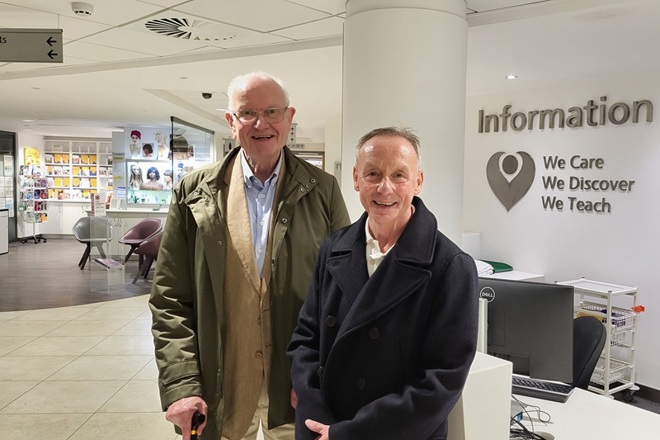
When Howie first arrived in Manchester in 1974, The Christie did not have a specialist leukaemia service and did not carry out bone marrow transplants. Acute leukaemia patients were treated on ordinary wards, often with limited facilities and staffing compared with modern standards.
As referrals increased, a small group of clinicians and researchers began developing plans for a dedicated service.
Howie said: "The Christie hadn't treated leukaemia at all. It hadn't done anything like bone marrow transplants. It didn't have any facilities. It didn't have any staff."
Working alongside colleagues including Professor Derek Crowther, Dr James Chang, Dr Godfrey Morgenstern and consultant radiotherapist Dr David Deakin, the team helped establish one of the North West's earliest adult bone marrow transplant programmes.
Their work was strengthened by a close partnership with researchers in the Paterson Laboratories, including Professor Sir Mike Dexter, Dr Nydia Testa and Dr Brian Lord. Together, they helped create an environment where laboratory discoveries could be translated into new treatments for patients.
For Derrick, the experience was life-changing. Although he later learned that his prognosis had initially been extremely poor, he remembers the hope the team gave him as treatment progressed. When doctors identified his younger brother Robert as an excellent donor match, a bone marrow transplant became possible.
Derrick said: "Bone marrow transplant was mentioned as my only chance of longevity. Very quickly testing took place to try and find a genetic match within my family, and I was extremely lucky to find that my brother was an extremely good match.
"Having hope made me feel extremely positive. It made all the difference to me."
His brother, then just 17 years old, immediately agreed to become his donor.
"The risks were high for me, but he was up for it. He just said, 'This is what we're going to do.'"
Howie remembers Derrick not only for his determination but also for his sense of humour.
While undergoing treatment and having lost his hair, Derrick fashioned a model of Dougal from The Magic Roundabout using a cardboard hospital urinal and his own hair. By the next ward round, he had built a kennel for it as well. The joke helped earn him the nickname "DD", after Dougal the Dog (and also the Double Diamond beer brand), while he in turn nicknamed his consultant Howard Scarffe "Big H".
As plans advanced for a specialist leukaemia and transplant unit, fundraising became a major challenge. The team spent countless evenings speaking at events and thanking supporters while seeking funding from charities, grant bodies and local communities.
The fundraising effort continues today through The Christie Charity, which has a dedicated haematology and stem cell transplant fund. The Charity has also played a major role in developing facilities for patients, contributing £10 million towards the £12 million cost of the Palatine Treatment Centre, which opened in 2014 and now houses the modern haematology and transplant service and a dedicated teenage and young adult unit.
Among the stories that became part of ALU folklore is Derrick's contribution to the fundraising campaign.
One day, he arrived at clinic carrying a plastic bag containing a single brick.
"It was such a drive to get this unit built," he recalled. "My dad was doing some building work and I said, 'I'm going to take a brick for Howie.' I thought at least it's a starting point. It was just a light-hearted thing really, but I think it touched Howie a little bit."
Derrick later ran the Manchester Marathon with his donor brother to raise money for the service and went on to lay the foundation stone for the new unit in 1985 when building work began.
"It was an exceptionally proud day," he said. "I was really honoured to be able to say a few words and be part of it alongside Howie, Godfrey Morgenstern, James Chang and all the other people involved. It felt like something very special was being created."
The Adult Leukaemia Unit opened in 1986, and Derrick was among those welcoming the Duchess of Kent for an official opening in March 1987
"She was very inquisitive about what had been achieved from a patient's perspective. She seemed genuinely interested in what treatment had meant for patients like me."
The unit quickly established a reputation for innovation.
Among The Christie's historic milestones was a world-first clinical trial involving cultured bone marrow. Working with researchers in the Paterson Laboratories, clinicians investigated whether patients' own bone marrow could be cleansed of leukaemic cells by being grown in the laboratory
Although the approach did not become routine practice, it represented a pioneering attempt to improve outcomes for patients who did not have a suitable donor and demonstrated the close partnership between clinicians and researchers that characterised the service.
Although the trial showed promise, the lengthy recovery period and subsequent advances in transplantation meant the technique did not become routine practice.
The unit’s major contribution with colleagues was the first published paper on G-CSF, a drug that stimulates the production of normal white blood cells after high-dose chemotherapy and helps protect patients from life-threatening infections.
It was shown that stem cells, normally found in the bone marrow, are released into the bloodstream by G-CSF and can be collected and used instead of traditional bone marrow. This avoided the need for a general anaesthetic and the discomfort of multiple needle insertions into bone.
Not only was this more convenient, but blood-derived stem cells accelerated recovery of blood counts, reducing the risks of infection and bleeding and allowing earlier discharge from hospital. This method spread worldwide and is still used today in what we know as stem cell transplants. Looking back, Howie said: "When I became a consultant, my aim was to cure at least one patient of leukaemia. I later thought, maybe Derrick is the one."
The original Adult Leukaemia Unit served patients for almost three decades before being replaced in 2014 by larger, purpose-built facilities within The Christie's Palatine Treatment Centre. While the physical unit no longer exists, the specialist service it established continues today through modern haematology and transplant services caring for patients from across the UK.
The impact of that legacy can be seen in Derrick's life.
After his transplant he married his wife Tracey, gained a degree in engineering and, despite being warned that treatment might make fatherhood unlikely, went on to have two sons, now aged 21 and 15.
"We never thought we'd be able to have children," he said. "Then they came along. It was just superb."
Derrick later required a heart transplant after developing treatment-related heart disease and is currently awaiting a kidney transplant, with the same brother who donated his bone marrow more than 40 years ago now being assessed as a kidney donor.
Despite those challenges, he remains characteristically positive. "Being treated at The Christie at such a young age gave me the strength and determination to deal with whatever life throws at you. I call it my Christie training.
"I've been exceptionally lucky. Somebody's been looking after me."
The anniversary event on 22 October brought together former patients, current and former staff, and supporters to celebrate four decades of progress in blood cancer care.
For Derrick and Howie, however, it as something more personal - a reunion between a doctor and a patient whose lives became intertwined at the very beginning of one of The Christie's most significant chapters.
Derrick has a simple message for the team that cared for him: "I'm so proud to be asked to take part. What Howie and his team achieved changed my life. Forty years later, I'm still here."
Among those joining Howie and Derrick were Michelle Gidion, a modern-day Christie haematology patient whose treatment demonstrates how research remains central to the service 40 years later.
Michelle, from Macclesfield, joined an international clinical trial of the targeted drug bleximenib after her acute myeloid leukaemia returned following chemotherapy and a stem cell transplant. She said she was delighted to be invited to the anniversary and to help recognise the patients, clinicians and researchers who have advanced blood cancer care across successive generations.