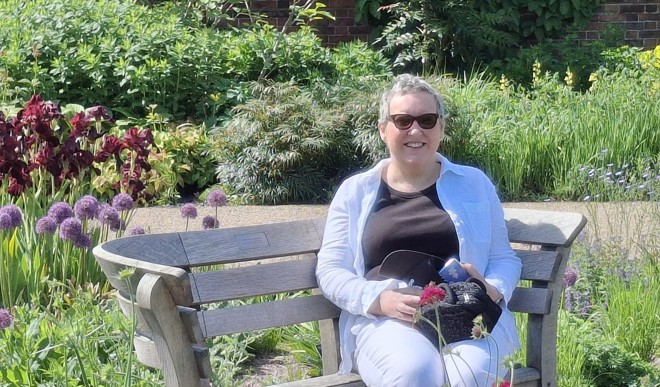
A woman who has spent more than 5 years living with advanced ovarian cancer has become the first patient in the world to receive a pioneering new cell therapy.
Tracy Tomlinson, 58, from Chadderton in Greater Manchester received the first dose of ZI-MA4-1 at The Christie NHS Foundation Trust as part of the ZIMA-101 clinical trial, evaluating a completely new type of cancer treatment.
For Tracy, this trial marks the latest chapter in a cancer journey that began shortly before Christmas 2020 and has included surgery, multiple courses of chemotherapy, cancer recurrence and countless appointments, scans and tests.
Despite everything, she has refused to give up hope. "I don't want to go anywhere," she said. "I've still got a lot of things that I want to do and things I want to achieve."
Tracy first realised something might be wrong when what she believed was a water infection failed to improve after antibiotics prescribed by her GP.
After blood tests, scans and further investigations, she received the devastating news just two days before her birthday. "They said, 'You've got cancer. Stage 3C ovarian cancer'," she recalls. "My very first thought was, 'I'm going to die.'
At the time, Tracy struggled to accept the diagnosis. "Never in a million years did I think it was cancer," she said. "I don’t smoke, I don’t drink, and I honestly thought they must have got my results mixed up."
After being referred to The Christie, Tracy underwent chemotherapy, surgery and several further rounds of treatment, including chemotherapy and maintenance therapies, but none worked for more than 12 months.
She describes going into ‘survival mode’. "It was just a case of, 'Right, what's next? I need to get through that.' It was a survival instinct more than anything."
By the summer of 2021, scans showed no evidence of disease.
But 12 months later, the cancer returned. Tracy had surgery and more treatment including maintenance therapy. Then came another recurrence. And another.
Since 2023, Tracy has lived with ongoing cancer, receiving additional lines of treatment while trying to maintain as much normality as possible. "The cancer is relentless," she said. "For me, it's never seemed to leave me alone."
The effects of treatment have included fatigue, sickness and nerve damage in her hands and feet, making some everyday activities more difficult.
She eventually stopped working as a credit controller after it became increasingly challenging to balance treatment and work.
Yet Tracy says cancer has also changed her outlook on life. "You appreciate people and the things around you more," she said. "I never realised trees were different colours of green until I got cancer. You hear birds tweeting that you've never heard before."
She added: "Cancer has taught me to be kind to myself. Before cancer I was very target-driven. Relaxing wasn't something I really did. Now I've learned it's okay to take time for yourself and not beat yourself up."
A major source of strength has been her husband Paul, whom she married in 2022, as well as her son Harry, wider family and the support she has received from The Christie and Oldham Cancer Support Centre.
As treatment options became more limited, Tracy began actively asking about clinical trials and she followed developments in cancer research closely. "I wanted to know what was out there," she said.
Last year, Tracy was referred to The Christie's early phase clinical trials team to explore whether she might be eligible for an experimental study, and she was eventually identified as a suitable candidate for ZIMA-101.
After intensive screening involving scans, biopsies, blood tests and specialist assessments, she learned she would become the first patient in the world to receive the treatment. "I decided almost straight away that I was going to go for it," she said. "Then afterwards you think, 'Am I doing the right thing?' because it is a little bit scary being the first person."
However, her confidence in the research team helped reassure her. "I've got tremendous confidence in The Christie," she said. "Professor Fiona Thistlethwaite and the team have made it very clear that my safety is paramount."
Tracy says she feels "very privileged" to have had access to the trial at The Christie.
“I felt very humble and emotional as the cells were infused for the first time. The treatment represented years of hard work from researchers, clinicians and everyone involved in developing it. It felt like a great first step for all of us."
Following her first dose of treatment, Tracy has remained as an in-patient at The Christie, as planned, being monitored regularly and was discharged on 23 July.
Looking ahead, she remains realistic but hopeful. "There are no guarantees with any trial," she said. "It could have a fantastic outcome, it could have no outcome, or somewhere in between. But if there is a possibility that it could work, I've got to go for it.
"If it benefits me, absolutely fantastic. But if it benefits other people in the future, that’s important too. I don't want to have gone through everything I've gone through for nothing. I want to feel like I have made a difference."
She added: "Cancer is no longer a death sentence. 5 years ago, I thought I was going to die but I'm still here."
A pioneering new approach to treating solid cancers
The ZIMA-101 study is evaluating ZI-MA4-1, the world's first MAGE-A4-targeting TCR-NK cell therapy to enter clinical development.
Developed by Zelluna, the treatment combines two powerful cancer-fighting approaches. It uses natural killer (NK) cells, specialist immune cells that can naturally identify and destroy abnormal cells, together with engineered T-cell receptors (TCRs), which enable the cells to recognise and target tumours producing a protein called MAGE-A4.
MAGE-A4 is found in several solid tumour types, including ovarian cancer, and is considered a good target for precision cancer therapies.
Unlike some personalised cell therapies that require cells to be collected and manufactured individually for each patient, ZI-MA4-1 uses donor-derived immune cells and is designed as an ‘off-the-shelf’ treatment. Researchers hope this could eventually make advanced cell therapies available to more patients, more quickly.
The trial also represents the first clinical evaluation of Zelluna's TCR-NK platform, which has been developed to overcome some of the challenges that have limited the effectiveness of existing cell therapies in solid cancers.
The study is being delivered with support from the NIHR Manchester Clinical Research Facility (CRF) at The Christie, whose specialist research laboratories have played an important role in processing patient samples throughout the trial.
Professor Fiona Thistlethwaite, consultant medical oncologist at The Christie and honorary professor at The University of Manchester said: "Tracy has shown remarkable courage throughout her cancer journey and we are incredibly grateful to her for agreeing to take part in this important research. Clinical trials only happen because patients like Tracy are willing to take part, helping future patients as well as themselves.
"While this is an early-stage study primarily focused on safety, it represents an exciting step forward in efforts to develop new treatment options for people like Tracy with advanced solid tumours. We hope the knowledge gained will help shape future cancer treatments and ultimately improve outcomes for patients."
Namir Hassan, chief executive officer of Zelluna, added: "Dosing the first patient in ZIMA-101 was a landmark moment for Zelluna and an important milestone in the development of our TCR-NK platform. It represents the moment when years of research moved beyond the laboratory and into the clinic, offering a new potential treatment option for patients facing advanced cancers with limited alternatives. We are deeply grateful to the first patient for placing their trust in this important research, and to Professor Fiona Thistlethwaite and the clinical teams at The Christie for making this milestone possible.
“We look forward to advancing the study and generating the clinical data that will help us better understand our novel approach and, we hope, contribute to improved outcomes for patients in the future.”