
A Disley man with blood cancer has become one of the first patients at The Christie at Macclesfield to benefit from new technology that can produce post consultation clinic letters on the same day they see their consultant.
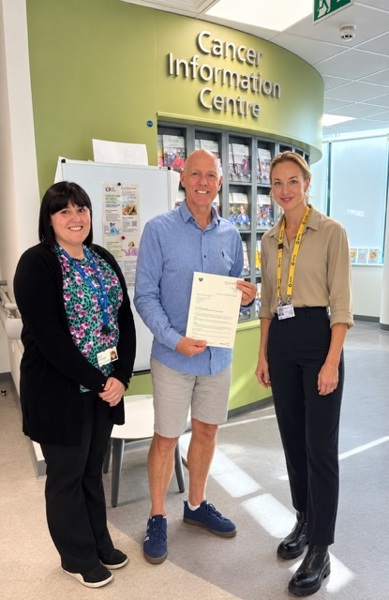
Ivan McKeever, from Disley, received his consultation summary almost immediately following an appointment with consultant haematologist Dr Faye Sharpley at The Christie at Macclesfield last week.
Dr Sharpley was using ambient voice technology (AVT) for the first time to create his letter.
AVT uses speech recognition and artificial intelligence to help clinicians create clinic notes and letters more efficiently. Clinicians remain responsible for checking, editing and approving all correspondence before it is sent to patients or GPs. The aim is to reduce administrative burden and help important information reach patients more quickly.
For Ivan, receiving his letter before leaving The Christie at Macclesfield last week meant he could immediately review what had been discussed during his appointment.
Ivan, 63, was diagnosed with asymptomatic myeloma in February 2026. His condition is under active surveillance at The Christie, but no treatment has been necessary so far.
"I was really impressed when I was given the letter before I left clinic," said Ivan.
"Normally you leave with a lot of verbal information to take in and then wait for the letter to arrive a week or so later. Having it straight away meant everything was fresh in my mind.
"It was reassuring to be able to read through what had been discussed even before I got home and know exactly what the next steps were.
"Having a clear record of the conversation straight away helped me feel more confident that I'd understood everything correctly.”
Dr Faye Sharpley, consultant haematologist at The Christie, recently began using AVT in her clinics and has become an advocate for the technology following her own experience.
"One of the biggest potential benefits of AVT is helping important information reach patients more quickly,” she said.
"Being able to provide documentation to patients much sooner can help reinforce key information and support conversations with family members and carers.
"Clinicians still carefully review everything before it is shared, but AVT can significantly reduce the time spent creating clinic documentation, both for me and my medical secretary."
Dr Sharpley said she had initially found the technology daunting but quickly became comfortable using it in real clinic settings. Just one day after attending training, she had successfully created her first clinic letters using the system.
"The first time can feel like a big step, but you learn very quickly by using it in a real clinic environment," she said. "Once you've done a couple of clinics, it starts to feel much more natural."
The rollout of AVT forms part of wider work at The Christie to explore how technology can support staff and improve patient experience. Clinicians remain responsible for all clinical decisions and all correspondence generated through the system is checked before it is shared.
For Ivan, the benefit is straightforward. "Anything that helps patients better understand what's been discussed and gives them information more quickly has got to be a good thing."