
Press release posted 5 November 2026
A cancer survivor living from Ramsbottom with the long-term effects of a rare cancer has become one of the first patients at The Christie to experience new artificial intelligence technology designed to give clinicians more time to focus on the person in front of them.
Karen Booth, 66, continues to receive care at The Christie after successful treatment for a rare cervical chordoma. Although her treatment was successful, she lives with significant lasting physical effects and continues to receive support through The Christie’s pioneering supportive oncology service.
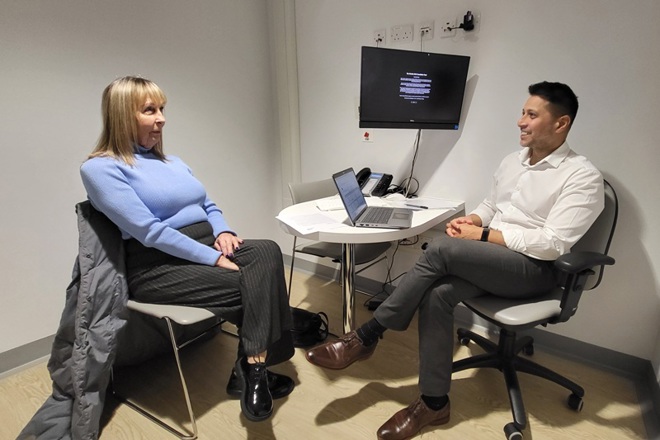
At a recent appointment, Karen experienced ambient voice technology (AVT), one of the digital innovations being introduced through Future Christie, The Christie’s programme to transform cancer care for the future.
AVT uses artificial intelligence to help create clinical documentation from the conversation between a patient and their clinician. Patients are asked for their consent before it is used, and clinicians remain responsible for checking and approving the information produced.
Karen said the technology quickly disappeared into the background of her consultation. “I remember my consultant asking my permission, and then I forgot it was there,” she said.
“What I noticed was that he was able to look at me the whole time and give me his full attention without having to look at a keyboard. That is important because it makes you feel included in the conversation.
“Receiving a clear clinic letter afterwards is important too because it reminds you of the important questions you’ve asked and what was clarified during the appointment.”
Early results at The Christie show that AVT can help clinical correspondence reach patients and GPs more quickly, while reducing the documentation burden on clinicians.
The technology is being rolled out across outpatient services as part of Future Christie, with the focus on using digital tools to support rather than replace the expertise and judgement of clinical teams.
Karen’s experience also demonstrates why improving cancer care is about much more than treating the disease itself.
She was diagnosed with cervical chordoma in May 2022 after several months of worsening symptoms. She was experiencing pain, falling and stumbling and had become increasingly afraid to go out.
“I knew it was something much bigger,” Karen said. “I had been unwell for a few months and was being treated with painkillers for what was thought to be a trapped nerve.
“I saw a neurologist in April 2022, and an MRI showed the tumour. I was admitted to Salford Royal immediately.
“Strangely, when I was finally told I had cancer, there was some relief because at last I had an answer for all the scary things that had been happening.”
Karen underwent two operations at the Royal Orthopaedic Hospital in Birmingham, where she had titanium rods inserted and her neck fused, before receiving proton beam therapy at The Christie.
Her treatment was successful, although an area being monitored could represent either residual disease or scar tissue. The consequences of her cancer and treatment, however, continue to affect everyday life.
“I get frustrated that I can’t stand straight and can’t walk very far,” Karen said. “I’m always in discomfort when I’m upright and I had to finish work because there was a lot I couldn’t do anymore.
“There are good days and bad days. It’s knowing I will never be quite the same and I guess there will always be that worry that the cancer might return.
“But that is balanced by the immense gratitude I have for all the first-class care I’ve received at The Christie."
Karen continues to receive care through The Christie’s supportive oncology service, which helps people manage the physical, psychological and practical consequences of cancer and its treatment.
The Christie was the first cancer centre in the world to establish supportive oncology as a formal directorate, bringing together expertise including whole pathway symptom and pain management, psychological medicine, medicines optimisation, endocrinology, senior adult oncology, survivorship and late effects, physiotherapy and occupational therapy.
Karen said that continuing relationship has helped her adapt to life after her main cancer treatment.
“Because I’d had my treatment at The Christie, when the main treatment was finished, I continued with oncology and that has been majorly supportive,” she said.
“They are fantastic and very well organised. Their support has kept me upbeat and positive. And spending lots of time with my family also keeps me going.”
“The ongoing appointments help me feel safe and valued. They make me feel that my life is important. If I think of something new, I want to ask, I have that opportunity.
“I never feel rushed or that I can’t ask anything. The staff are all unique in their own way, but they make you feel that you matter.”
Karen hopes her experience will also reassure other people living with and beyond cancer that they should continue asking for the information and support they need.
“Cancer is scary, but so many people do survive and receive the best care,” she said.
“My advice is to ask all the questions you want to ask and don’t ever feel silly for asking them. Knowing that the support is still there makes a huge difference.”
Dr Ashique Ahamed, consultant in palliative and supportive care at The Christie, said: “Karen’s experience demonstrates why supportive oncology is becoming increasingly important as more people live after cancer treatment.
“Finishing treatment does not necessarily mean the end of someone’s cancer experience. Our role is to help people live as well as possible with the longer-term consequences.
“Innovations such as ambient voice technology can support that approach by reducing some of the documentation around a patient consultation, while the clinician remains responsible for reviewing everything it produces.
“The real benefit is not the technology itself. It is creating more opportunity to focus on the patient, listen carefully and understand what matters most to them.”