
This information tells you about the procedures known as biliary drainage and stent insertion.
What is a biliary drainage?
One of the normal functions of the liver is to produce bile needed for the digestion of food. The bile drains through a series of small tubes called ducts and eventually into one larger duct (the common bile duct). The common bile duct empties into the first part of your bowel after your stomach, called the duodenum.
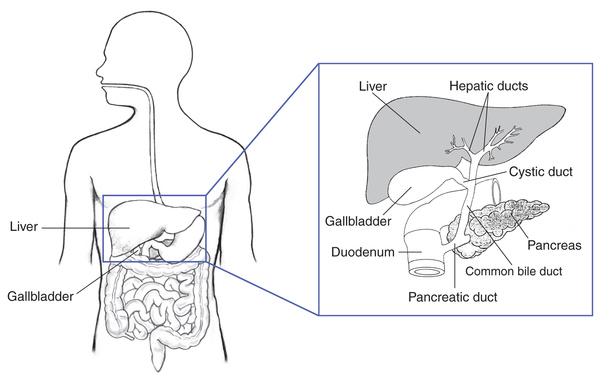
If the bile duct becomes blocked then bile cannot drain normally. The liver cannot function properly and jaundice develops. This is potentially a very serious condition which needs to be treated. As the bile is not excreted properly in the bowels, the stools turn paler, urine goes darker and the skin may start to itch all over.
It is possible to relieve the jaundice and the build-up of bile in the liver by putting a fine plastic drainage tube (catheter) through the skin into the obstructed bile duct. This allows bile to drain into a collection bag for a while. This is called a percutaneous (through the skin) biliary drainage, or PTC.
Once a drainage catheter is in the bile duct, it is usually possible to pass it through the blockage and into your bowel. This allows the bile to drain in the normal way.
What to tell the doctor
- If you have any allergies.
- If you have had a previous reaction to intravenous contrast medium (the dye used for some X-rays and CT scanning).
- It is important to tell the doctor or the radiology department before attending for admission.
- If you are taking medication to prevent blood clots. Below is a list of some of the medications which are used to thin the blood and help to prevent blood clots.
- Apixaban
- Clexane
- Dabigatran
- Enoxaparin
- Rivaroxaban
- Aspirin
- Clopidogrel
- Dalteparin
- Fragmin
If you are currently taking any of these medications, please contact your referring doctor or the radiology department on 0161 918 2346 as soon as possible, as these may need to be stopped prior to your procedure. Failure to do so may result in your procedure being postponed.
What is a biliary stent?
Stents are flexible hollow tubes usually made of thin metal wire and between 6 and 10 centimetres long and 1 centimetre wide. A stent may be placed in the narrowed part of the your bile duct to hold it open. If you need a stent it may be done as part of the drainage procedure, or carried out a few days later.
Why do I need a biliary drainage (and) a stent insertion?
Other tests that you may have had such as an ultrasound, CT or MRI scan, have shown that your bile duct has become blocked. This may be due to a tumour or swelling around the bile duct or sometimes gallstones. Your doctors will have discussed with you the likeliest cause of the blockage and the possible treatments.
Who has made the decision?
Your doctors and the radiologist doing the biliary stent and insertion will have discussed the situation with you and feel this is the best treatment option.
Agreeing to treatment
We will ask you to sign a consent form agreeing to accept the treatment that you are being offered. The basis of the agreement is that you have had The Christie’s written description of the proposed treatment and that you have been given an opportunity to discuss any concerns. You are entitled to request a second opinion from another doctor who specialises in treating this cancer. You can ask your own consultant or your GP to refer you.
Your consent may be withdrawn at any time before or during this treatment. Should you decide to withdraw your consent, then a member of your treating team will discuss the possible consequences with you.
Who will be doing the procedure?
A specially trained doctor called a radiologist. Radiologists have special expertise in using X-ray and scanning equipment, and also interpreting the images produced. They need to look at these images while carrying out the procedure, to make sure the drainage catheter and stent are positioned correctly.
Where will the procedure take place?
In the integrated procedure unit (IPU) in the special X-ray procedure room.
How do I prepare for a biliary drainage and stent insertion?
You will be asked to attend the IPU and following your procedure, you will be admitted to one of the wards where you will stay for a few days. We will ask you not to eat for 6 hours beforehand, though you can drink clear fluids (water, black tea, black coffee) up to 2 hours before the procedure. We will ask you to put on a hospital gown.
You may be given some antibiotics to take before the procedure. You will have a cannula (fine plastic tube) placed in a vein in your arm, so that you can be given a sedative and some painkillers.
What happens during a biliary drainage and stent insertion?
- On arrival at the IPU you will have the opportunity to discuss the procedure with the radiologist. They will explain all the benefits and possible risks associated with this procedure, and you will be asked to sign a consent form.
- You will lie on the X-ray table, generally on your back. You will already have a cannula in the vein in your arm so that you can be given a sedative and painkillers as needed. The sedative will make you feel sleepy. You will also have monitoring devices attached to you. You will be given extra oxygen through small tubes in your nose.
- When you are sleepy the doctor will use ultrasound to decide on the best place to insert the catheter. This is done between 2 of your lower ribs, on your right side or in the midline of the tummy below the ribs. The skin over this area is cleaned with antiseptic fluid and you will be covered in sterile sheets.
- The doctor will give you an injection of local anaesthetic which will cause some stinging at first, but then the area will go numb.
- The radiologist will use the ultrasound and X-rays to insert a needle into your liver. Once the needle is in the right position, contrast (dye) is used to show up the bile ducts.
- A fine guide wire will be placed through the needle and used to guide a drainage catheter into your bile duct.
- The catheter will then be fixed to the surface of your skin with stitches and a drainage bag will be stuck to the skin over the catheter.
- In some cases a stent will be placed at the same time using the same puncture site, or you may return a few days later to have a stent placed. A temporary drain may be inserted for a few days after successful stent placement.
Will it hurt?
We will give you painkillers and sedation, but you may still feel some pain during the procedure.
You may have some discomfort as the catheters are passed into the bile ducts, but this wears off very quickly. If the blockage needs to be dilated this may hurt for a few seconds, but you will receive additional painkillers and sedation.
Sometimes there may be a small bile leak from the bile duct during or after the procedure. This can be quite uncomfortable. We will give you more painkillers to control any pain if needed.
If you do feel any pain, you must ask the nurses looking after you for some painkillers to keep it under control.
How long will it take?
Every patient’s situation is different, and it is not always easy to predict how long it will take. The procedure will probably take between 45 to 60 minutes. As a guide expect to be in the radiology department for about 1 hour and 30 minutes.
What will happen afterwards?
You will be taken back to the ward on a trolley once you are awake. Nurses on the ward will carry out routine observations, such as your blood pressure and pulse. You will generally stay in bed for a few hours, until you have recovered.
You may have some pain after the procedure, but you will be given painkillers for this.
How soon can I eat and drink?
Most people are able to drink fluids and have something to eat when they are fully awake.
How long will the drain stay in?
This depends on your condition and the reason you have the drain in, but normally just for a few days. In some patients, however the drain will need to stay in permanently. If this is the case, the radiologist performing the procedure will discuss this with you as part of the consent form.
How long will the stent stay in?
It is a permanent stent. Most people are not able to feel it.
Are there any risks and complications?
Biliary drainage and stent insertion is considered a safe procedure, but there are some risks and complications, as with any medical treatment.
- Sometimes it is not possible to access the bile ducts. If this happens your doctors will arrange to repeat the procedure or another method to open up the blockage.
- Infection can occur in bile ducts. If you are thought to be at risk then you will be given antibiotics to help prevent this. Rarely, if there is a lot of infection in the bile duct you could develop sepsis (spread of infection to the blood) after the procedure. Antibiotics should limit this.
- As people with jaundice are more likely to have difficulties with blood clotting, there may be slight bleeding from the surface of the liver where the catheter is inserted.
- On rare occasions a blood transfusion may be needed. On very rare occasions, the bleeding may become severe and you may need an operation or another procedure to stop it.
- The stent may not expand fully and you might still have symptoms. This is treated in the radiology department by placing a small balloon inside the stent and inflating it so that the stent expands fully.
- The stent may slip out of position or get blocked in the weeks or months after stenting. This may be obvious because your jaundice returns. We will see you and probably place another stent.
Despite these possible complications, the procedure is normally very safe, and the benefit of the biliary drainage and/or stent outweighs the possible complications.
What are the alternatives?
The major alternative to biliary stenting is surgical repair. This may not be an option for you as you may be considered too unwell for surgery.
Inserting the stent may not be possible due to previous surgery, so may need to be done using an endoscope (ERCP). This is not available at The Christie. However, percutaneous biliary drainage is usually performed if ERCP is not suitable or available.
What happens next
The catheter is stitched to the skin and placed inside a drainage bag which is then attached to your skin. The drainage bag needs to be emptied regularly. The ward nurses must measure and record the amount of bile that is collected. If a lot of bile is drained you may have to have extra fluids through the cannula in your vein. Normal bile is a dark green colour. Sometimes it takes a few days for clear or pale bile to return to normal.
You may have to have further scans to check if the drain or stent is working, or a further procedure. Your drain may be removed at this time. This will be discussed with you during the procedure.
Further information
This is available from the radiology department on the phone numbers below or from the following websites:
- Macmillan Cancer Support: www.macmillan.org.uk
- Cancer Research UK: www.cancerhelp.org.uk
- British Liver Trust: www.britishlivertrust.org.uk
- Digestive Disorder Foundation: www.digestivedisorders.org.uk
- British Society Interventional Radiologists: www.BSIR.org
Contacts
If you have any concerns or questions, call the radiology department on 0161 918 2346. Monday to Friday, 9am to 5pm.
Out of hours and at weekends, ring The Christie Hotline on 0161 446 3658 (24 hours a day, 7 days a week).