
In 2006 when his son Oakley was only two years old, Quentin Webb was given just months to live after being told he had advanced kidney cancer. 20 years on, he is cancer-free and raising money to help fund the next breakthrough in cancer research.
Quentin, an Explorer Scout leader from London, has raised money for Manchester’s Christie Charity since his diagnosis as a way of thanking the hospital that saved his life. In 2006, Quentin and his wife Helen were told there were very few treatment options for patients with advanced kidney cancer. Quentin’s consultant then referred him to The Christie NHS Foundation Trust, where clinicians were pioneering the use of high-dose interleukin-2 (IL-2) therapy; the very first immunotherapy approved for the treatment of cancer.
The Christie was one of the only hospitals in Europe offering this early form of immunotherapy and two years after Quentin first began his treatment, his cancer was almost eradicated. Following further surgeries in metastatic sites (areas where the cancer has spread), Quentin was declared cancer-free.
Today, Quentin is in complete remission and has raised tens of thousands of pounds towards building a future where more cancers are detected earlier, treatments are kinder and more effective, and more patients can live longer, fuller lives.
In 2008, while still in treatment, Quentin and his close friends raised £24,000 for The Christie Charity by driving ‘old bangers’ they had bought for under £500, through 12 European countries in one week.
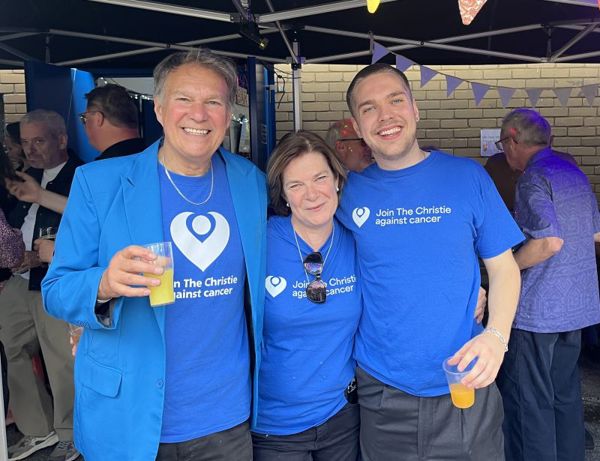
In 2016, to mark 10 years since his diagnosis, he hosted Quent10, a celebration of life festival at a local Scout camp site, raising £12,000. This year, 2026, he hosted Qwenty, another festival at his Scout HQ to commemorate two decades since his diagnosis. Over two hundred friends and family members attended, raising over £12,000 for The Christie Charity Gene and Immunotherapy Fund.
Quentin said: “In London, we were told there was no hope. We are so grateful to The Christie - one of the only hospitals in Europe offering this early form of immunotherapy. Finding my way to The Christie changed everything. Nearly 20 years later, I’m still here. I’ve watched my son grow up, I’ve renovated our home, and I’ve done the most amazing things I never thought I’d get the chance to enjoy.
“Research is all about giving other people that same chance. When I was diagnosed, it was clear that conventional treatment wouldn’t work. I had to think about my 2-year-old growing up without a dad, and my wife without a husband. Research at The Christie gave me the future I was told I wouldn’t have.
"The fundraising efforts of the people before me helped develop the treatment I was given. Thanks to decades of cancer research, immunotherapy is now an established option for many people with cancer, but the treatment I was on has been replaced by more advanced methods. We're treating cancers today that only a few years ago would have been deadly. Now it’s my turn to pave the way for the next generation of cancer patients.”
Helen Webb, Quentin’s wife said: “We could not be more grateful for Quent’s treatment. From being told he had months to live to where we are now, not a day goes by that we don’t feel grateful to The Christie for the impact it’s had on our lives.
“Unfortunately, our outcome isn’t always how these stories end. 460 people are dying from cancer every single day in the UK, and we still have a very long way to go to bring that number down.
“Throughout our journey, many of our questions were answered by “we just don’t know yet” or “we don’t really understand why this is happening”. That is not the way it has to be.
“We don’t just fundraise because The Christie saved Quent’s life, we fundraise because we want them to save more.”
Louise Hadley, Chief Executive Officer at The Christie Charity, said: Quentin’s story shows us what cancer research can make possible. A treatment that was once experimental is now a standard way we treat cancer. That progress has been built on decades of research, which has in turn been funded largely by the fundraising efforts and donations of everyday people.
“Unfortunately, there are still too many cancers where we don’t have the answers. That is why The Christie Charity has pledged to invest £30 million in cancer research by 2030. We want to help researchers ask the next big questions, give more patients the opportunity to take part in research and bring tomorrow’s treatments to the patients of today sooner.
“Quentin was told he had months to live. Twenty years later, he is celebrating with his family and raising money to give others the same chance. That is why research is so important.”
As 24 September marks World Cancer Research Day, The Christie Charity is calling on supporters to help fund the next generation of cancer research and give more patients like Quentin the chance of a future beyond cancer.
Research such as this is central to The Christie Charity's commitment to supporting The Christie hospital’s vision of ‘learning from every patient’ and trebling the number of patients participating in research by 2030. Studies have shown that cancer patients treated at research-intensive hospitals have better outcomes than those treated in hospitals with little or no research activity.
To support the work of The Christie Charity, please go to Donate today (christie.nhs.uk or ring 0161 446 3988.
The Christie Charity supports the work of The Christie NHS Foundation Trust providing enhanced services over and above what the NHS funds. This includes money for care and treatment, research, education, and extra patient services. Gifts from the public make a huge difference to the care and treatment that The Christie is able to provide to cancer patients and their families.