
A £100,000 award from a charity founded by people affected by rare abdominal cancer is accelerating world-leading research at The Christie NHS Foundation Trust.
The funding from Pseudomyxoma Survivor, awarded to The Christie Charity, is supporting the development of a highly sensitive blood test for detecting pseudomyxoma peritonei (PMP) and will be one of the first of its kind globally.
PMP is a slow‑growing but complex cancer that usually starts in the appendix. It affects just 3 or 4 people per million. One of the biggest challenges in treating the disease is detecting it. PMP only releases tiny amounts of tumour DNA into the bloodstream. This means most standard cancer blood tests are not sensitive enough to detect the disease. By the time patients are diagnosed, the disease has often spread to the lining of the abdomen, making treatment far more complex.
Current treatment involves major surgery that can take around 10 hours to remove as much of the tumour as possible, followed by heated chemotherapy delivered directly into the abdomen. The operation varies between patients, but can include removing part of the bowel, the spleen, the surface of the liver, the gallbladder, the fatty layers in the abdomen, the womb and ovaries, the belly button and the lining of the abdomen.
This intensive procedure requires a highly skilled surgical team and places significant physical, emotional, and financial strain on patients and the NHS.
There are 2 primary centres that perform this surgery in the country. One of these is The Christie in Manchester and the other is The North Hampshire & Basingstoke Hospital in Basingstoke.
Researchers at The Christie Colorectal and Peritoneal Oncology Centre, led by professor Omer Aziz together with the Cancer Research UK National Biomarker Centre, are developing a blood test that looks for a much more detailed ‘fingerprint’ of PMP in the blood.
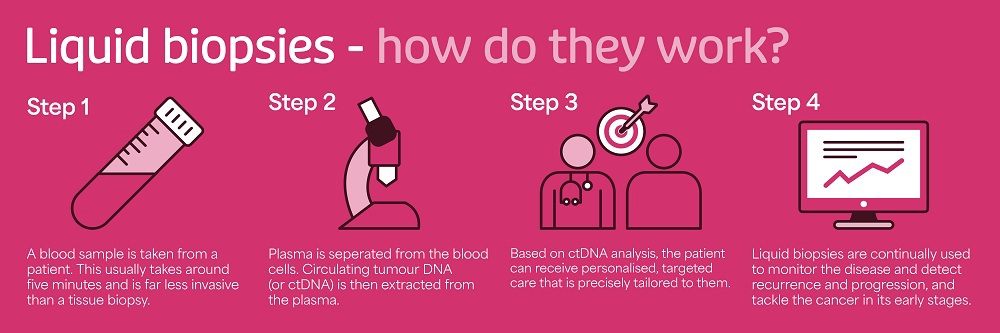
Instead of searching for one type of tumour signal, the new test looks at 3:
- Methylation patterns – chemical markers sometimes described as a tumour’s DNA ‘barcode’
- DNA mutations
- DNA fragmentation patterns – the distinctive way DNA breaks down when cancer cells die
By combining these signals, scientists hope to detect even the smallest traces of PMP in a patient’s blood meaning the disease can be caught and treated before it spreads.
A central part of this project is creating the first in‑depth reference dataset showing what PMP tumours look like at a DNA level.
Thanks to Pseudomyxoma Survivor’s £100,000 funding, researchers will analyse tumour samples from PMP patients to build this detailed map. This will allow future blood tests to personalise monitoring for patients and provide a reliable PMP‑specific test even when no tumour sample exists.
This is a major step toward giving patients more personalised, confident, and timely information during follow‑up care. If successful, the new blood test could detect recurrence earlier than current methods, reduce uncertainty during follow-up care, provide more personalised information to clinicians and patients and reduce reliance on invasive procedures and imaging. Recurrence is not uncommon for patients of this rare cancer. Earlier diagnosis will improve treatment paths and the outlook for those impacted by a return of the disease.
Tim Brill, Trustee of Pseudomyxoma Survivor and a former PMP patient himself, said: “For people living with pseudomyxoma peritonei, uncertainty can be one of the hardest burdens to carry. Our community knows what it feels like to wait for answers between scans. By funding this tumour ‘fingerprint’ research, we’re helping build a future where patients can be monitored more accurately and with less fear. Supporting research that improves patient outcomes is exactly why Pseudomyxoma Survivor exists.”
Dr Raghavendar Nagaraju, Translational Research Fellow at The Christie and CRUK National Biomarker Centre, said: “PMP is exceptionally difficult to monitor because it sheds so little tumour DNA into the bloodstream. This generous support from Pseudomyxoma Survivor and The Christie Charity allows us to address that challenge directly. By studying the unique biological signature of these tumours in unprecedented detail, we are laying the foundations for a blood test that could transform how patients are followed up after treatment.”

Professor Caroline Dive, Director, Cancer Research UK National Biomarker Centre, said: “Rare cancers like PMP have historically been left behind. By applying advanced methylation sequencing and integrating multiple tumour signals, this project represents a highly innovative approach to overcoming the low-shedding challenge. It is an important step toward bringing precision diagnostics to patients who urgently need better monitoring tools.”
The blood test research for PMP forms part of a wider programme of pioneering biomarker research at the Cancer Research UK National Biomarker Centre, which aims to develop next‑generation blood tests to detect cancer earlier, predict relapse, and guide treatment decisions. This includes the development of advanced, proprietary blood‑based approaches to help resolve cancers of unknown primary (CUP), where the original tumour site cannot be identified using standard diagnostic tools.
Research such as this is central to The Christie Charity's commitment to supporting The Christie hospital’s vision of ‘learning from every patient’ and trebling the number of patients participating in research by 2030. Studies have shown that cancer patients treated at research-intensive hospitals have better outcomes than those treated in hospitals with little or no research activity. The Charity has pledged to support and fund this goal with £30m over the next 5 years to accelerate research and innovation in Manchester, with the ultimate aim of bringing tomorrow’s treatments to patients faster.
To support the work of The Christie Charity, please go to Donate today or ring 0161 446 3988. To directly support patients and carers of this rare cancer, go to the Pseudomyxoma Survivor website.
The Christie Charity supports the work of The Christie NHS Foundation Trust providing enhanced services over and above what the NHS funds. This includes money for care and treatment, research, education, and extra patient services. Gifts from the public make a huge difference to the care and treatment that The Christie is able to provide to cancer patients and their families.
*The mission of the Cancer Research UK National Biomarker Centre is to discover, develop, validate and qualify biomarkers (indicators of what is happening in a patient’s tumour) in clinical studies and trials that detect cancer earlier, predict risk of relapse after treatment, and anticipate and monitor therapy responses to inform and support optimised treatment of patients with cancer.