
What is radiotherapy?
Radiotherapy is a localised treatment that uses high energy X-rays (radiation) to treat cancer. The radiotherapy treatment machine is called a linear accelerator (linac), and it directs radiation beams to the treatment area. These machines are found in the radiotherapy department (department 39) at The Christie. There are also treatment machines at Salford, Oldham, and Macclesfield, however most patients with head and neck cancer will have their treatment at the main site in Withington.
How does radiotherapy work?
Radiotherapy damages the DNA of cells in the area being treated. Our normal cells can repair this, but as cancer cells are not normal, they cannot repair this damage and are destroyed. Treatment is given in small doses (fractions) over a set period of days or weeks. This means we can destroy the cancer cells while minimising damage to normal areas.
Radiotherapy does not make you radioactive and you are safe to be around other people (including children and pregnant women).
Why is radiotherapy given?
Radiotherapy can be given in the following situations:
- on its own to cure the cancer
- with chemotherapy to cure the cancer
- following surgery to reduce the risk of the cancer coming back (recurrence)
- following surgery with chemotherapy to reduce the risk of the cancer coming back
- on its own as palliative (non-curative) treatment to improve symptoms
This information will explain what will happen before, during and after treatment to help guide you through your treatment. It will also explain some of the expected side effects. How severe side effects are can be different for each patient.
How is treatment decided?
All patients with head and neck cancer are discussed in a weekly multi-disciplinary team (MDT) meeting. This involves head and neck cancer surgeons, oncologists (cancer doctors), nurses, and a range of experts. During these meetings each case is discussed in detail, with a review of scans and biopsies. From this, a treatment plan is recommended.
What will happen at my first appointment?
The first appointment at The Christie is an opportunity to meet the consultant who is going to oversee your care.
You may initially be seen by another member of the team, such as a resident doctor or advanced clinical practitioner. You will have a detailed discussion about your current symptoms, general health, lifestyle factors and diagnosis.
Based on this information, the clinician will recommend a treatment plan, and this will be explained to you. This will include the intended benefit, the practicalities and the potential side effects of the treatment.
You will also meet the wider head and neck team. This includes the specialist nurse, dietitian, and speech and language therapist (SLT) . You may be invited back to clinic for an extra appointment to see the dietitian and SLT before your treatment starts. This is to discuss nutrition and swallowing in more detail.
Agreeing to treatment
Consent to treatment
The doctors and nurses will give you written information to support what they have explained about your treatment.
We will ask you to sign a consent form agreeing to accept the treatment that you are being offered. The basis of this agreement is that you have had a written description of the proposed treatment and that you have been given the opportunity to discuss any concerns. You will be given a copy of the consent form. You are entitled to a second opinion from another doctor who specialises in treating cancer. You can ask your own consultant or GP to refer you.
You will be then asked to attend the blood room for a blood test and the pharmacy to collect a prescription for head and neck supportive medications.
What happens after the first appointment?
You will receive a phone call (from a withheld number) shortly after your first appointment. This is to arrange a radiotherapy planning appointment. This will be at The Christie in Withington or at one of The Christie at sites (Macclesfield, Oldham and Salford).
Radiotherapy treatment is extremely precise, it is important that patients are in the same position every day. The first step in your radiotherapy treatment is to make a mask, which will be individual to you and help ensure accurate treatment. This will be part of your radiotherapy planning appointment.
The mask is made by warming a sheet of thin perforated plastic which is placed over and shaped to your face while you are lying down. As it cools, it becomes hard which results in a custom-made tight-fitting mask. You will be able to see and breathe through this mask throughout. If you have an altered airway, such as a tracheostomy, an opening can be made around this.
Once the mask is made, you will be asked to have a radiotherapy planning scan. This may be with intravenous (IV) contrast dye.
When having your radiotherapy planning scan, it is important to remain relaxed and avoid swallowing (if possible).
It is important to note that this is for planning your radiotherapy only and you will not get a formal report or result from this. Once the scan is done, this will be used by your consultant to plan your treatment. This can take 2 to 3 weeks.
When you attend for your radiotherapy mask and scan you will be given your start date and appointments for your radiotherapy treatments. Please ensure you have this list of appointments before you leave your appointment.
Your first treatment
Treatment is given Monday to Friday between 7am and 9pm, although this may vary depending on availability. Treatment is not usually given at weekends but is given on most bank holidays.
It is not always possible for you to have treatment at a preferred time. If you need a specific time for treatment or have difficulties attending at the treatment time you have been given, please discuss this with the radiotherapy support worker.
You will be lying flat during treatment, wearing your custom-made mask secured to the treatment bed. You will be alone in the room but the radiographers delivering the treatment are just next door and can talk to you over a speaker. They will be able to see and hear you if you wish to ask a question or need assistance. You will not feel anything during treatment, but you may see and hear the machine as it rotates around you.
Each treatment takes around 15 minutes each day. Immediately before some of your treatments, while on the treatment bed, you will have a special type of CT scan called a cone beam scan. This is done to make sure that you are in the correct position only.
We know patients get the best results when they finish treatment without any missed treatment days. Even if you are feeling unwell please try to attend for your radiotherapy, you can be seen by a member of the team when you arrive.
Treatment review
During your radiotherapy, you will be seen in the treatment review clinic. You will be given appointments for this as part of your schedule. During this appointment, you will be seen by one of the head and neck consultants, resident doctors, or advanced clinical practitioners. You may also see a clinical nurse specialist.
Please note: this is your opportunity to ask for the pain relief that you require for the week ahead.
Outside of these hours, if you need a repeat prescription, you will need to speak to the radiotherapy team or The Christie Hotline. However, this may take longer. You will see a dietitian and speech and language therapist regularly throughout your treatment.
Chemotherapy
Chemotherapy is often given with radiotherapy (chemoradiotherapy) in head and neck cancer. If your consultant feels you will benefit from this, it will be discussed with you.
Chemotherapy is the use of drugs to treat cancer. The 2 most common chemotherapy drugs used are cisplatin and carboplatin. The consultant will offer you the most appropriate chemotherapy drug. This will be fully discussed with you at the time and you will be given further information.
Chemotherapy is given once a week for 6 to 7 doses during the radiotherapy schedule.
Before each chemotherapy session, you will need a blood test to ensure that it is safe to proceed. You will be asked to have this done on a Monday.
Please note: chemotherapy is generally given on a Tuesday or a Wednesday (depending on the start date of radiotherapy).
Cisplatin
Cisplatin is the most used chemotherapy drug in head and neck cancer.
Cisplatin is given once a week as an infusion (drip) over about 4 hours. Cisplatin has some side effects, and these will be discussed with you by your treating team. They are also outlined on the consent form, and you will receive a copy of this.
The most common side effects include:
- kidney problems (to help avoid these, drink lots of fluid, normally around 2 to 3 litres every day)
- nausea (vomiting is less common) – you will be given strong anti-sickness medications to prevent this
- tinnitus and hearing loss
- risk of infection (you will need to obtain a thermometer)
You will be asked if you are happy to go ahead with the chemotherapy treatment and to sign a consent form.
Carboplatin
Carboplatin is also often used in head and neck cancer.
Carboplatin is given once a week as an infusion (drip) over 30 to 60 minutes.
You may be offered carboplatin from the start. This might be because you already have some hearing loss or tinnitus or if you have pre-existing kidney problems or other health conditions that would make carboplatin preferable. Alternatively, you may start off your course with cisplatin. However, if you experience troublesome side effects, we may suggest you change over to carboplatin. This will be fully discussed with you at the time.
Staying well-hydrated on chemotherapy and radiotherapy
Drinking enough fluid and being well-hydrated is extremely important during treatment. If you are having chemotherapy as well as radiotherapy, it is even more important.
You can drink any non-alcoholic fluids to keep hydrated. The best drink is water (with or without sugar free squash or flavours) but you can also drink milk, juice, tea and coffee.
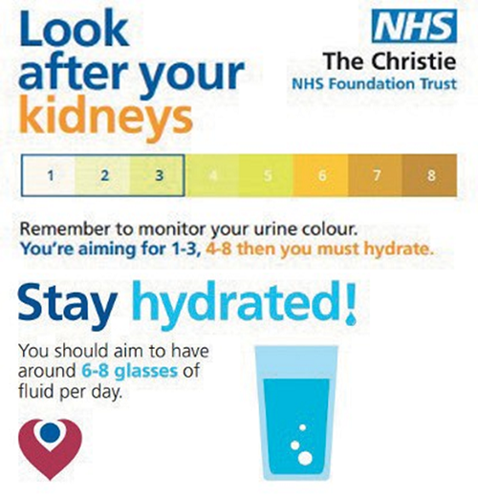
The picture below shows a good way of checking if you are drinking enough. Look at the colour of your urine when you go to the toilet . If it is one of the colours (1, 2 and 3) in the box, you are likely to be drinking enough. If it is more yellow or even brown, you need to drink more. If you don’t feel you can, because of pain or sickness, please ask to see your treating team to discuss this.
Outside normal working hours, you can ring The Christie Hotline on 0161 446 3658 for advice and help.
If you are using a nasogastric or gastrostomy tube for feeding, make sure you take plenty of fluids via the tube. One way to do this is to use extra flushes or larger flushes before and after feeds and before and after every medicine that you take.
Altered airway and radiotherapy
During your radiotherapy and/or chemoradiotherapy treatment it is important that you continue to care for your airway. When you attend for treatment, please ensure that you have supplies with you, such as cleaning swabs and a spare tube. If you use a nebuliser, please continue to do so. You may find you need this more often to help with humidification and to expectorate (clear) secretions during your treatment. If you require suction while you are here please ask, as suction machines can be made available for you to use. Please do not hesitate to speak to the team if you have any concerns.
What are the side effects of treatment?
Although the actual delivery of radiotherapy is painless, there are side effects that occur in the short and long term. These will be in the consent form you will be given for head and neck radiotherapy. Below are listed some of the short and longer-term side effects. There may be other side effects not listed here. The likelihood of these side effects is shown on the consent form.
How severe side effects are differs for each patient. Your consultant and team will discuss these with you in more detail in the outpatient appointment.
Pain
One of the most challenging side effects of radiotherapy can be pain in the mouth, the throat and the neck. This tends to start in the second week of treatment and peaks shortly after your radiotherapy has finished, before gradually settling down.
To manage this, we recommend a combination of different pain relief, keeping your mouth clean, stopping smoking and avoiding alcohol or spicy food. See the sections on medication, mouthcare and stopping smoking below for more information.
We hope that pain settles soon after radiotherapy, but patients can continue to have mouth ulcers and pain on swallowing that may last for weeks to months post-treatment. It is essential that once pain starts to improve you start to reduce your pain relief. Further information on mouthcare, medication and stopping smoking is provided below.
Mouthcare during and after radiotherapy
Mouthcare during head and neck radiotherapy is extremely important as radiation treatment can have significant effects on the oral cavity (mouth). Good oral hygiene and care can help many of the common side effects including:
- reducing pain
- preventing infection
- helping you to continue eating and drinking
Your mouthcare regime
|
Mouthwash/ rinse |
Solution |
Benefits |
Frequency/ directions |
Tips |
|---|---|---|---|---|
|
Saltwater (saline) |
Dissolve 1 level teaspoon of table salt in a pint of water. |
Helps with your dry mouth and reduces the risk of infection. |
Please use 10mls of both mouthwashes every 2 hours throughout the day. |
Make up these formulas daily to use throughout the day. Bring this with you when you attend for treatment. |
|
Sodium bicarbonate |
Dissolve 1 level teaspoon of sodium bicarbonate in a pint of water. |
Helps manage excessive or thickened secretions which can be uncomfortable and difficult to clear. |
||
|
Difflam/ benzydamine |
This will be provided on a prescription. |
Helps with oral discomfort as has anti-inflammatory and antiseptic properties. |
Please use 10mls 4 times per day in addition to other mouthwashes. |
Can be used before/after meals to help with oral pain. Can be diluted if stings. |
- Gentle brushing: Use a soft toothbrush and high fluoride toothpaste to clean your teeth.
- If you wear dentures: Rinse carefully after each meal under running water to remove food particles . Clean dentures at least twice daily in a sink of warm water.
- Hydration: Drink plenty of fluids.
- Avoid irritants: Avoid spicy foods, tobacco, and alcohol which can further irritate the mouth. If your mouth is sore, leave dentures out when possible.
- Other mouthwashes: please avoid use of any other mouthwashes, DO NOT use Corsodyl (chlorhexidine) during your treatment as it may make side effects worse.
- DO NOT SMOKE.
Taste
Changes in taste can be one of the first changes/side effects that you notice. This can make it difficult to find things to eat and drink that you enjoy. It can affect your appetite, mood and your weight. Although there is no way to prevent this, there are various things that can help. These include using regular mouthcare, varying your diet, pro-actively treating any infection and trying different or new flavours.
The priority is to maintain your weight and you may need to adapt your diet, focusing on calories rather than flavour. Our dietetic team will review you as you go through your treatment to help with this and support you with your taste changes. Recovery of taste can take up to 18 months, but long-term changes are possible.
Weight loss
Maintaining your weight on treatment is very important as it can help you cope better with the treatment side effects and ensure that you stay as strong as possible throughout your treatment and recovery. Weight loss can reduce your ability to fight infections, to withstand treatment side effects and to heal damaged tissues after radiotherapy. It is also important to keep weight loss to a minimum to ensure that your radiotherapy mask continues to fit well.
During treatment, you will be weighed weekly. It can be challenging to meet your nutritional needs with food alone during radiotherapy. The dietitians will support you to increase your calorie/protein intake to try and help you to maintain your weight. Nutritional supplement drinks are effective at helping to get the calories and nutrition you are missing and may be essential during your treatment.
You may find that you can only manage liquids/nutritional supplement drinks, particularly towards the end of your treatment due to the side effects.
The dietitians will advise you on how many nutritional supplement drinks you will need to maintain your weight. You will be given a copy of The Christie booklet ‘An easier to eat, nourishing diet’ which includes useful tips and advice on how to eat well when you are experiencing pain or discomfort on swallowing.
If you have lost weight during your treatment, you may find that it is difficult to get back to your normal weight after treatment, even though you may be eating quite well. This is common and, if your weight is steady, it is usually not a problem. You will be offered a referral to a community dietitian service if needed.
Feeding tubes
Eating and drinking can become very difficult during radiotherapy treatment, and you might need some extra help to stay nourished. Your team may talk to you about a feeding tube to help get food directly into your stomach. This tube can also be used for fluids and medication . If required, the tube might stay there for a few weeks or months while you get stronger.
Some patients may have a thin tube placed into their stomach through their nose (nasogastric tube). This type of tube is inserted while you are on treatment and sometimes requires an admission to the ward – usually around a week.
Sometimes we will place nasogastric tubes as an outpatient, avoiding the need for hospital admission. In this case, the nasogastric tube will be placed earlier on in your treatment while you are still well and able to eat and drink. We will let you know if this service is suitable for you and if so, provide you with all the necessary details. Please speak to your dietitian to find out more information regarding feeding tubes.
Others will have a tube placed directly in their stomach (gastrostomy tube) before or during treatment if they have difficulties with their swallowing or maintaining their weight. This normally involves a short procedure and a hospital stay.
Swallowing difficulties
Swallowing is a complicated process using multiple different muscles to ensure that food enters the oesophagus (gullet/ food pipe) and avoids entering the lungs. Radiotherapy and/or cancer can affect swallowing in both the short and long-term. Due to the presence of tumour or radiotherapy-induced inflammation, this delicate mechanism can be disrupted, causing swallowing muscles to be weak or stiff. Our speech and language therapy team will be able to help you if your speech and/or swallowing are affected by cancer or its treatment.
Signs to look out for:
- coughing when eating or drinking
- frequent throat clearing
- wet, gurgly sounding voice
- food sticking in your throat
- liquids coming back up through your nose or mouth
- feeling of food and/or drink going down ‘the wrong way’
These signs may indicate that your swallow has become uncoordinated which can lead to food or drink entering the airway. This may lead to a chest infection which can be serious. Symptoms include a raised temperature or coughing up green phlegm.
The speech and language therapists will discuss with you how the treatment may affect your swallowing. Your swallowing will be assessed, and you will be given some exercises to support and help maintain your swallowing muscles.
Voice care
Your voice might get hoarse as treatment goes on. The best ways to look after your voice are:
- avoid whispering and shouting as these can strain your voice box
- stay well-hydrated
- try to cut down or avoid caffeine as this can be irritating
- rest your voice when you can
- try to avoid clearing your throat too much
- use your mouthwashes to clear any secretions regularly
- do not smoke or vape or spend time around people who are smoking or vaping
- cut out background noise where you can such as turning off the TV to talk
Dry mouth
Most head and neck cancer patients develop a dry mouth during and after treatment. Treatment techniques are designed to minimise this, however, due to the location of the salivary glands this can be difficult. For most patients this is manageable. They require more water during meals and overnight. Artificial saliva can provide some relief .
Sometimes a medication called pilocarpine is used to help this, although responses to this are mixed. The dryness is often at its worst post-treatment and may improve in the months to years that follow. This can be permanent.
Thick secretions
Radiotherapy can also cause thick mucus in the mouth and throat. It can help to sip water frequently and maintain good oral hygiene, by following the mouthcare advice outlined earlier.
A nebuliser can also help if you are struggling despite the measures above. A nebuliser is a device that changes liquid medication to a fine mist that you breathe in. It can make your secretions more manageable and easier to cough up.
Please discuss this with one of the specialist nurses or advanced clinical practitioners. But please note availability of nebulisers can be limited.
Swelling under the chin, mouth and neck (lymphoedema)
Many patients experience swelling to the face, mouth and neck. This is called lymphoedema and develops in the weeks following treatment. Symptoms of lymphoedema may include visible swelling, deepened skin folds, indentations from clothes, difficultly moving your head, neck and shoulders, reduced voice projection and difficulties with swallowing.
There are several things you can do to reduce your risk of lymphoedema including looking after your skin to reduce the risk of infection by daily washing and moisturising, daily mouthcare, cleaning your teeth and/or using mouth washes and regular head and neck exercises to improve movement and lymph drainage.
You will be given a copy of The Christie leaflet ‘Exercises for patients having radiotherapy to the head and neck’ which shows you the exercises you should do to help prevent and manage lymphoedema to the head and neck.
If lymphoedema does occur, a lymphoedema specialist can advise you on things that can be done to help reduce the swelling and discomfort. Please talk to a member of your team for a referral.
Tiredness
Tiredness, or fatigue, is commonly experienced during and after cancer treatment. The severity and timing of this can vary from person to person and and depends on many factors.
Fatigue management
- Keep well-hydrated.
- Make sure you have good nutritional intake to minimise weight loss.
- Try and keep your sleep pattern as normal as you can.
- Take regular light exercise (such as walking).
- If you can, do resistance exercise, aerobic exercise, or other activities such as Tai Chi during treatment and the recovery period. This has been shown to reduce fatigue and help your recovery.
- Complementary therapies can also help.
If you are struggling or want further advice, please speak to the treating team.
Skin reaction
Radiotherapy to the head and neck area can cause a skin reaction. This is expected and is not a burn, although it can look like sunburn. During treatment the skin may become red or darker, itchy and sore. It can then start to peel, become moist and scabs can form. Skin reactions often appear gradually over the course of treatment and heal slowly.
Keeping the skin hydrated will help to make you more comfortable. We have specific creams and dressings which can help if the skin starts to peel. You should let one of the radiographers or specialist nurses know if this occurs.
Skincare during and after your radiotherapy
Here are some key skincare tips for patients undergoing head and neck radiotherapy. Following these skincare guidelines, you can help reduce the discomfort and promote healing during and after radiotherapy.
Gentle cleansing
Use a mild, fragrance-free soap or cleanser. Avoid products with alcohol, fragrances, or harsh chemicals, as these can irritate the skin. Please DO NOT use aqueous cream.
Moisturise
Hydration is key, apply fragrance-free moisturiser regularly at least twice a day.
During your treatment, you will have regular assessments of your skin. Your treating team may provide personalised skincare recommendations from these assessments. Please follow their guidance and inform them of any changes in your skin.
Protect your skin
Avoid hot water, hot packs, or heating pads, as excessive heat can further irritate the skin. If you need to use a hairdryer, please use this on a cool setting.
Avoid wearing clothing that rubs on the skin of your neck.
Please avoid wet shaving, if possible, use an electric razor for the duration of your treatment and recovery.
Skin which has had radiotherapy treatment is more sensitive to sunlight. Avoid direct sun exposure and always wear a total sun block cream when going outdoors once your treatment is completed.
Following treatment, you may notice that your skin is slightly different (often darker) than before. This can be more noticeable in darker skin. Occasionally the skin can become stiffer making turning your head more difficult therefore it is essential to continue to move your neck (see lymphoedema exercises) and take pain relief to try and prevent this.
Further information about skin reactions can be found in the radiotherapy department.
Stopping smoking
We strongly advise current smokers to stop smoking while having this treatment . If you would like help with stopping smoking, a free, confidential smoking cessation and alcohol advice service is available for patients and carers at The Christie, providing helpful advice and treatment.
Tel: 0161 956 1215 or 07392 278 408.
Hormone function
Radiotherapy to the neck can affect the function of your thyroid gland. We recommend all patients who have had radiotherapy to the neck to have their thyroid function checked 1 year after treatment.
Please ensure you arrange this with your GP.
Dental problems (including osteoradionecrosis of the jaw)
When your mouth is dry, your teeth are no longer protected by saliva and are more prone to decay. This can lead to long term problems with the teeth, which can be serious. Dental assessment and the removal of unhealthy teeth before radiotherapy (preventing the need for dental surgery in the future) along with good dental hygiene (including the use of high fluoride toothpaste called Duraphat) is recommended.
Please note that we are unable to prescribe Duraphat, this needs to be provided locally by your GP or dentist. We can provide a letter to help if required.
Helpful tips to maintain weight while looking after your teeth:
- enrich foods with fats rather than sugars, speak with your dietitian for more information
- nutritional supplements should be taken with meals or in as few sittings as possible, however this may not be possible as treatment progresses
- use a high fluoride toothpaste such as Duraphat – ‘spit and don’t rinse’
- use a mouthwash recommended by your team after eating/drinking something sugary then wait 30 minutes before brushing . A high fluoride mouthwash can be used post-treatment – discuss with your dentist
- ideally brush your teeth before nutritional supplement consumption and then 30 minutes after
- use a wide bore straw where possible
- brush teeth regularly
Radiotherapy can occasionally cause serious damage to the jaw (osteoradionecrosis). The risk of it is highest in patients with tooth extractions in the treated area . You can help minimise the risk by:
- stopping smoking
- maintaining good dental hygiene
Medications
The main pain medications that we use are paracetamol, pregabalin and morphine (Oramorph). It is usual to start on paracetamol alone at first, as your pain increases additional strong pain killers will be prescribed. It is vital that these medications are taken together for the best level of pain relief.
Pain relief and the exact dose and timing is tailored to each patient.
Paracetamol
Paracetamol is the most important supportive medication that we provide during treatment. It is available in tablet, capsule, dissolvable and liquid form. This should be taken 30 minutes before meals. This should start early in radiotherapy and can continue for as long as required post-treatment.
Paracetamol is safe, however taking more than prescribed can be dangerous.
Pregabalin
We use pregabalin to help control nerve pain associated with head and neck tumours and the inflammation caused by radiotherapy. It is available in capsule or liquid form.
Pregabalin should be taken twice a day on a regular basis. After starting on a small dose, we will gradually increase this over the course of your treatment.
Pregabalin is a well-tolerated drug. The most common side effects are drowsiness and dizziness.
Morphine
Morphine is a very safe form of pain relief. During radiotherapy, it can help significantly with the pain associated with inflammation of the mouth and throat. It is to be used ‘as required’ for patients when they are in pain. The head and neck team will advise you how to take this medication.
Morphine can make people feel tired and constipated. When taking morphine, patients need to ensure that they are on a regular laxative which will be prescribed by the head and neck team.
Fentanyl
Morphine-based patches (fentanyl patch) are often used during radiotherapy. This comes in various doses, and you will be prescribed a dose which is appropriate for you.
The medication gets absorbed through the skin, providing continuous pain relief. The patch needs to be replaced every 72 hours (3 days).
The side effects of these patches are very similar to that of the morphine. If you develop side effects or become drowsy, the patch should be removed. It may take several hours for the side effects to wear off. Please inform us of any concerns.
Patches need to be disposed of correctly and kept away from babies and small children.
You should never reapply a fentanyl patch after a period without them.
Constipation
Constipation can occur because of changes in diet and medications (stronger painkillers like morphine or anti- sickness after chemotherapy). You can use laxatives to help you maintain regular bowel motions. All patients taking morphine-based pain relief should be taking a laxative.
Drinking plenty of fluid and keeping mobile will also help to prevent constipation.
Driving on medications
It is illegal to drive while on prescribed drugs if these affect your ability to do so safely. This includes oramorph, lorazepam, oxycodone, pregabalin and fentanyl.
It is your responsibility to decide whether you are fit to drive on each occasion.
Further information is available in The Christie leaflet ‘Driving while taking strong pain killers and other sedating medicines’.
Stopping medication
It is important that as the side effects of treatment settle the doses of pain medications are slowly reduced with the aim of stopping completely. Reducing these medications too quickly can result in withdrawal, which is usually not dangerous but can be unpleasant. Once your pain starts settling you will find that you are using less short-acting/breakthrough medication (Oramorph or oxycodone), typically this is about 2 to 4 weeks after completion of radiotherapy.
The head and neck team at The Christie will advise you how to safely reduce your medications. Usually, the first medication to gradually reduce is the fentanyl patch (morphine pain patch). While doing this, short-acting/ breakthrough medication can be used as you come off the fentanyl patch. The next medication to gradually reduce then stop is pregabalin. After a few weeks, you will find that you should be able to stop any breakthrough medication as well. The last medication to stop is the paracetamol which can be continued as needed.
It may take 2 to 3 months to come off your pain medications completely. If you are struggling, please inform the head and neck team.
Treatment completion and follow-up
Treatment review clinic
In the last week of treatment, patients will be given 2 weeks of medication, and a letter will be sent to your GP so that you can collect further prescriptions locally.
Outpatient appointments
Routine follow-up is 6 weeks after completion of treatment. This will be in the main outpatient department (dept 22) . However, if you are struggling in the time before this appointment this can be brought forward. This can be arranged by contacting your key worker.
At this appointment your current symptoms will be checked, and your doctor will arrange for post-treatment scans.
A blood test may be requested so that intravenous (IV) contrast can be given at the time of the scan. Patients who have been treated for a very early vocal cord cancer do not require a scan.
Post-treatment imaging
Your first post-treatment scan will be performed 3 to 4 months following completion of treatment. This will usually be a PET CT scan, an MRI scan or a CT scan. Occasionally it will be a combination of these. It will take 2 to 3 weeks to get the report from your scan and your outpatient appointment will be timed in accordance with this.
If you have not had your scan, and your outpatient appointment for the scan results is approaching, please contact the team secretary.
Before your outpatient appointment you will be asked to fill in an online health questionnaire to assess ongoing side effects to help guide the consultation and for toxicity reporting. This is called MyChristie MyHealth, and we would be grateful if this could be completed before appointments. Note: this will not be seen by a clinician until your appointment. For urgent queries, contact The Christie Hotline.
Discharge from The Christie
Post-treatment patients are discharged from The Christie and will be followed up by the local head and neck surgical teams.
Dietetics and speech and language therapy follow-up
Once you complete your radiotherapy, you will no longer be seeing the dietitians and speech and language therapists at The Christie regularly. If you are having issues with your speech, swallowing or nutrition you will be offered a referral to your local dietetics and speech and language therapy teams, who will take over your care and continue to support you with your nutrition and swallowing. If you are taking nutritional supplement drinks, the dietitians at The Christie will make sure that you have an ongoing supply of these.
We would recommend continuing your swallowing exercises after you finish treatment, to support and maintain long term swallowing function.
Sex, contraception and fertility
Protecting your partner and contraception
We recommend that you or your partner use a barrier form of contraception during sexual intercourse if you are having a course of chemotherapy. Chemotherapy and radiotherapy is dangerous to unborn babies, and this will also protect you and your partner from any chemotherapy drugs that may be present in semen and in the vagina. If you suspect that you may be pregnant, please tell your doctor immediately.
Fertility
Chemotherapy may affect your ability to have children. Your doctor or nurse should have discussed this with you. If not, please ask them before you start treatment.