Press release posted 23 February 2026
Young cancer patients can now use Minecraft to explore what it’s like inside the proton beam therapy centre at The Christie, in Manchester. This is believed to be the first time that a working NHS health facility has been accurately reconstructed within the game.
The new Minecraft world is the result of a collaborative partnership between The Christie NHS Foundation Trust and Microsoft, and Minecraft Education to create a virtual version of The Christie’s proton beam therapy centre inside Minecraft.
Designed with input from The Christie’s clinical and health play specialist teams, the Minecraft world helps children and young people become familiar with key areas of the proton beam centre before real‑life treatment begins. The aim is to reduce anxiety, encourage questions and create a sense of curiosity about the proton centre and treatment for young people at an unfamiliar time.
Staff at Manchester cancer centre hope the new play environment will help to reduce the anxiety that young patients feel when they come for their first proton beam therapy treatment.
The Christie treats approximately 120 paediatric patients each year with a specialist type of radiotherapy called proton beam therapy. Proton beam therapy is a type of radiotherapy.
Protons are small particles found in the middle of atoms. They can be used to give carefully calculated doses of radiation to treat diseases. Protons release their energy at an exact point in the body. This means the dose to the tumour can be given very accurately and there is little or no dose to normal tissue past the tumour.
Proton beam therapy maximises the therapeutic dose to the patient’s tumour while minimising damage to healthy tissues.
Carefully -crafted areas can be explored in Minecraft, including reception, the atrium, waiting areas, imaging rooms, the play preparation room and the centre’s school/education space. The Minecraft world will also allow young people to follow corridors to interactive MRI and CT scanners and to peek into consulting spaces, treatment gantries, and ward recovery bays.
Interactive touches, including a working MRI, working taps, computer screens, a playable keyboard piano, and discoverable ‘secret rooms,’ offer moments of lightness alongside clinically accurate features. The Minecraft version has been scaled up to around five times the size of the real centre to make navigation easier and provide clear sightlines.
The Minecraft Education team used photographs and details gathered during site tours, along with additional reference material supplied by The Christie, to ensure accuracy. All patient‑facing spaces are represented to reflect what families actually see and do during treatment. The health play specialist team will support and guide the sessions and the conversation for each child.
To protect the experience during guided sessions, the core environment will be made ‘immutable’ (not destructible), with optional zones where children can build safely if encouraged by staff.
The Minecraft proton beam therapy centre has been developed primarily by Microsoft’s Paul Flaherty and Joanne Healy in a voluntary capacity, with contributions from Microsoft early careers staff, apprentices, and volunteers.
10-year-old Ramatulaye, or Rama for short, lives in Bradford with her family. She has Hodgkin lymphoma, a type of blood cancer, and had chemotherapy at her local hospital before coming to The Christie for proton beam therapy, which is a form of radiotherapy.
Rama was the first patient to explore the proton beam therapy centre in Minecraft.
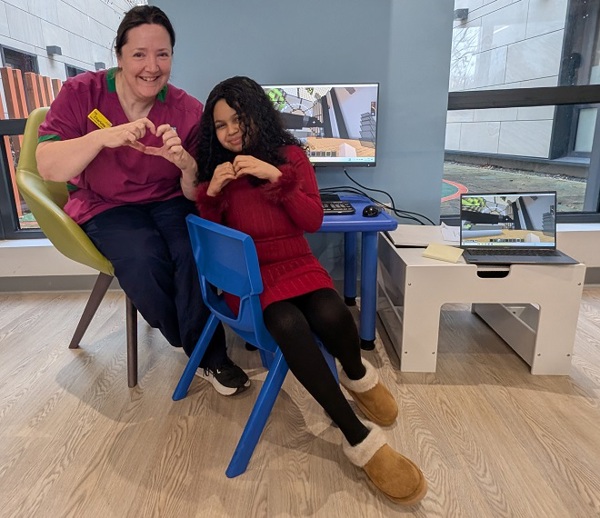
“It looks just the same as the hospital, it’s so cool,” she says. “I got to explore the playroom and the gantry where I have treatment every day. The hospital feels very big when you get here, so being able to explore it in Minecraft helps you to understand where everything is which is great. I think other children would love it just as much as me.”
Joanne Healy, Microsoft developer, said: “Working with The Christie’s team helped us focus on the moments that matter most to young patients, from arriving, to meeting staff and seeing the equipment. Our goal was to make a faithful, calm space with a few playful touches so children can explore at their own pace, ask questions, and feel more confident.”
“This project also aligns with Microsoft’s ‘Beyond the Badge’ campaign this year, which encourages us to use our skills through volunteering and inclusion initiatives that support community wellbeing.”
Proton beam therapy centre manager at The Christie, Tom Edwards, added: “Having seen through my own children, how fascinated they are by Minecraft, I knew that this would be a fantastic way for our young patients to explore the proton beam centre and overcome their fears. That’s why I was so excited to work with the Minecraft developers to help them build a version of our proton beam therapy centre in Minecraft.
“We are really grateful to Microsoft and all their volunteer coders who have created this amazing way for our patients to gain confidence before their treatment.”